Why an owner cannot do without an owner's representative in Switzerland
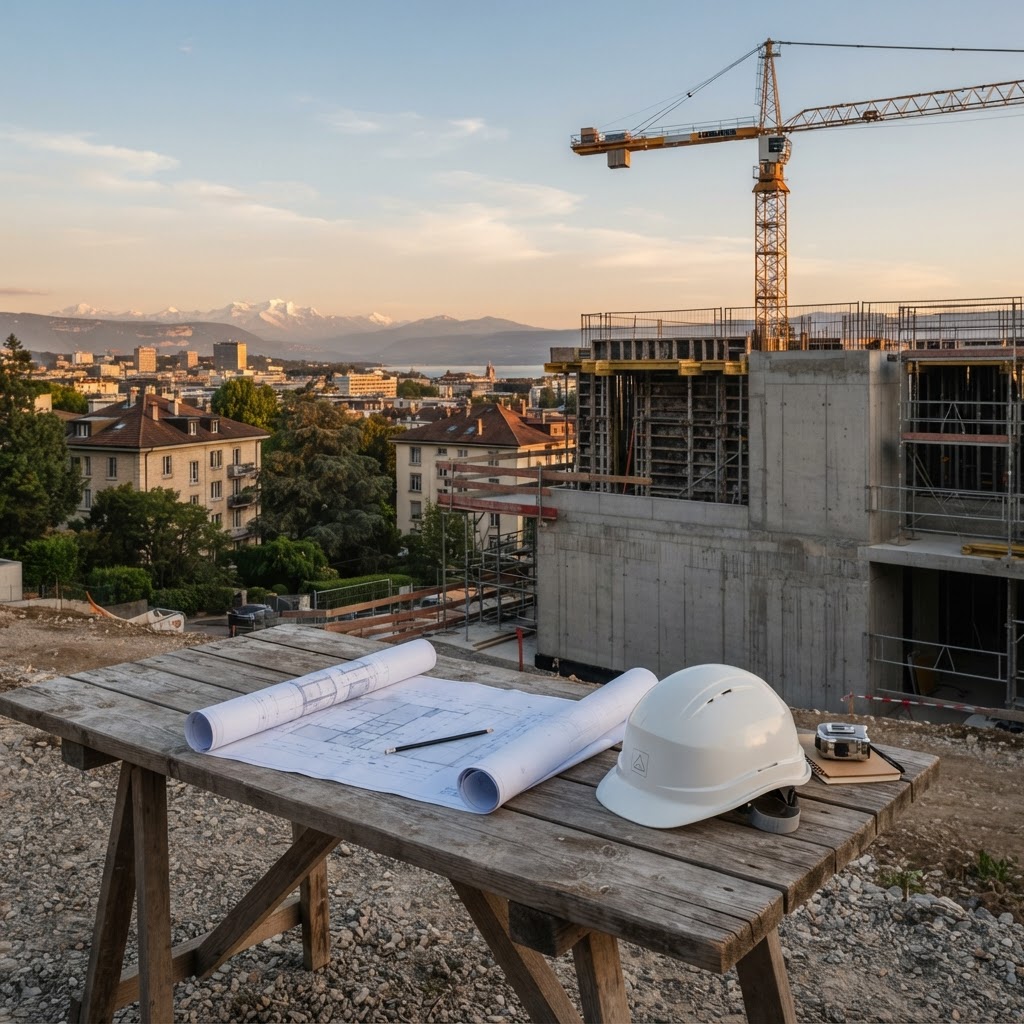
In French-speaking Switzerland, an owner who builds without an owner's representative is not saving money: they accept a risk they have never quantified. The role is not a luxury reserved for large operations. It is the tool that allows an owner, an investor or a company to remain in control of an operation in which almost everything is organised so that decisions escape them.
Building, transforming or renovating remains complex, and the owner is almost never a construction specialist. At KERLINE, the construction arm of OAKS GROUP SA, we hold that role every day in Geneva and in the canton of Vaud (Construction client advisory in French-speaking Switzerland).
The finding: one party carries the result
A project mobilises dozens of parties: architect, structural and MEP engineers, surveyor, geotechnical engineer, notary, bank, contractors, state services, municipality, neighbours. Each defends its interests, its fees, its schedule and its liability. One party carries the final result: the owner. They pay, they sign, and they answer in law.
Yet they are often the least equipped around the table. A private individual building a villa, an SME extending its premises, a pension fund buying land: none of them routinely reads a tender, an execution drawing or a cost breakdown. The representative restores the balance, and their contribution starts where the most expensive decisions are taken (The importance of the owner's assistant).
Three developments make the role more necessary than ten years ago.
Procedures are getting longer. In Geneva, motion M 3216 tabled in the Grand Council on 24 March 2026 cites an average of more than 500 days for a new building. It is not yet an adopted reform, but it documents a reality every project owner knows.
Costs are more volatile. Materials, energy, mortgage rates: a budget fixed at the outset no longer holds without active management.
Requirements are piling up. Energy, densification, heritage, housing, accessibility, biodiversity: each layer adds a ground for refusal or appeal.
Who does what: five roles not to confuse
The first value of an owner's representative is to put each party back in its place. Many project drifts begin with confusion: an architect arbitrating the budget, a general contractor alone setting the finishes, an owner convinced everything has been delegated.
The representative is an assistant: they pass on information, the owner decides. They are not the owner's delegate, the only person empowered to commit the owner. The distinction determines who answers in the event of an error: a representative answers for the quality of their advice, under a mandate governed by articles 394 et seq. of the Code of Obligations; a delegate also commits the owner towards third parties. In practice the two functions combine: KERLINE is mandated as the owner's representative and coordinates contractors, architects, engineers and authorities from planning to delivery (OAKS GROUP services). Practical rule: the contract must state plainly whether the mandate is advice only or includes signing, and up to what amount.
What the owner never delegates
Even when everything is entrusted to a general contractor, the owner keeps obligations of their own. The representative does not remove that responsibility; they make it manageable.
Defining the need and the budget. Programme, surfaces, standard, financial envelope, target schedule. A vague programme is the first cause of variations, and no architect or contractor can fix it without a conflict of interest.
Funding and paying. Equity, construction loan, release conditions. Banks often require a level of reservations or sales before releasing funds.
Signing contracts. Architect and engineer mandates, general contractor or trade contracts, insurance. Each signature commits the owner, not their adviser.
Carrying the owner's liability. The owner answers for excessive emissions towards neighbours (art. 679 and 684 CC) and, once the building is in use, for construction or maintenance defects (art. 58 CO).
Watching the legal mortgage risk. An unpaid subcontractor can register a legal mortgage on the property (art. 837 CC) within four months of completing their work. The owner may therefore pay twice: it is one of the most underestimated risks.
Accepting the works and notifying defects. Handover, recorded in minutes, opens the warranty period. Since 2026 the deadline for notifying defects is 60 days instead of a few days, and the right to free repair can no longer be excluded by contract. A longer deadline is no substitute for a serious technical inspection.
Complying with the permit. The conditions of the building permit bind the beneficiary. In Geneva, a permit lapses if work does not start within two years of publication, unless extended.
All these obligations require technical, legal or financial skills the owner does not necessarily have, and time they almost never have. They may not know how a floor area ratio is calculated; they cannot ignore that they bear the consequences. The representative works precisely in that gap, turning each obligation into a prepared decision: costed options, named risks, a reasoned recommendation.
The role at every phase: from feasibility to keys
The most common mistake is calling a representative once the site is drifting. At that stage they can only limit the damage. Their value lies upstream, where most of the cost is already fixed by programme and design choices, while almost nothing has yet been spent. The SIA 112 model, which divides a project into six phases, is the shared reference.
Upstream: studying the potential before paying. On a Geneva plot, the analysis starts with the zoning. In a villa zone, the reference floor area ratio is 0.25 under the LCI. Then come easements, noise, protected trees, access and soil pollution. A single one of these can halve the buildable area. A representative sees it before the deed is signed, not after (Land in Geneva: the true price is calculated before the offer). The right contractual reflex is a sale promise conditional on a permit in force: the authorisation risk stays with the seller as long as possible.
Midway: permit and award. This is the phase where time costs most: the owner pays interest on land that produces nothing. The representative sets a realistic schedule, anticipates pre-approvals and organises dialogue with the municipality and neighbours. Timelines vary widely between cantons and must be built into the financing rather than suffered (Construction permit delays in Switzerland). Then comes the award: fixed-price general contractor, turnkey contractor, or separate trades coordinated by construction management. A fixed price reassures but is paid for in margin and variations; separate trades cost less but demand tight management. The representative helps choose, then puts the offers on a comparable basis.
Downstream: site and delivery. The representative is the owner's eye: quality, cost, schedule. They check every payment claim before payment, every variation before approval, every slippage before it becomes a delay. At the end they prepare the handover, list reservations, track their clearing and check the building file is complete, including subcontractor payments. A mission can be global, from plot to keys, or targeted: a legal structure, a permit file, a tender review, a handover expertise.
Geneva and Vaud: two cantons, two logics
In French-speaking Switzerland, construction law is cantonal and often municipal. Two plots on either side of a cantonal border answer to different laws, different services and different timelines.
Geneva: time is the first cost. The application is published in the official gazette, then 30 days of observations open; the department in principle has 60 days to answer, excluding suspensions, a deadline often exceeded. After the decision, 30 days to appeal. The permit is only in force at the end of that period or of the final judgment. Motion M 3216 sums up the problem: more than 500 days on average. Meanwhile equity stays immobilised, interest accrues and contractor offers must be refreshed. A representative does not shorten the law; they reduce the time lost around it: a complete file at submission, anticipated pre-approvals, fast answers to requests for further information.
Vaud: the municipality at the centre. The Municipal Council issues the permit and grants the energy bonus, as well as the bonus for public-service housing. The municipal regulation sets the base index, and that is what weighs most: the same plot does not have the same potential in Nyon, Rolle or Lausanne. Bonuses accumulate under conditions: on 1,200 m² with a floor area ratio of 0.55, the base of 660 m² rises to 759 m² with the energy and public-housing bonuses, +15%, in exchange for 114 m² of public-service housing.
The example that sums it up
On a 900 m² plot in a Geneva villa zone, the base is 225 m². It rises to 247.5 m² under HPE and 270 m² under THPE. If the plot sits within a densification perimeter of the municipal master plan, the figure reaches 396 m² under HPE and 432 m² under THPE. Registration in the municipal plan alone makes a difference of 162 m².
In Geneva, 162 m² are counted in millions of francs. An owner who sells without knowing it, or a buyer who pays without checking, leaves that sum on the table. Three levels must be checked before a surface is taken for granted: the base index, the bonuses actually available, and the geometric envelope (distances, heights, unbuilt ground).
The owner from elsewhere
One case makes the role almost indispensable: the owner who does not know the local market. A foreign company setting up in Geneva, a German-speaking group building in Vaud, a family returning after twenty years abroad. All have the means to build; none has the bearings.
What is missing is not general competence but fine knowledge of the ground: real prices, local rules (Geneva LCI, Vaud LATC, municipal regulation, development zones, the LDTR, lakeside protection), the players, and the administrative culture, which is only learned by practising. The LDTR alone changes how a building may be renovated or transformed (LDTR in Geneva).
For institutional investors the logic is the same with other stakes: a pension fund must justify its decisions to a foundation board, and the representative provides an independent, documented and traceable analysis. For a private buyer of an off-plan property, the permit number and its publication must be checked, the permit must be in force, the sales plans must match the approved plans, and a condition precedent with full refund of the deposit must be required.
What the role delivers: cost, time, risk
Fees are visible and certain; avoided losses remain invisible until they happen. The real question is therefore not "what does a representative cost?" but "what does a project cost without one?".
The cost of time. On land and a project worth CHF 8 million, with a carrying cost estimated at 2.5% a year, each month of delay costs about CHF 17,000 in interest, before any lost sales or rent. These months are rarely lost in one block: an incomplete file, an unanticipated pre-approval, a decision that waits because nobody prepared it.
The cost of variations. A poorly defined programme in phase 1 becomes a series of changes in phase 5, when each change costs most. The representative fixes the programme before tendering, then challenges unjustified variations and costs the legitimate ones.
The cost of risk. A legal mortgage from an unpaid subcontractor, a hidden defect after handover, an unanticipated neighbour appeal, an overestimated buildable area: any one of these can exceed the cost of a full mission.
The value created. Optimising building rights, choosing the label that actually triggers a bonus, adapting the unit mix to demand: these decisions change the return. The THPE label in particular must be arbitrated on technical grounds, not on a sticker (THPE villas in Geneva).
The arithmetic is rarely tight: on a multi-million project, one avoided quarter of delay or one badly negotiated variation covers the fees.
The limits of the role, and why they are a strength
It does not decide. It analyses, recommends and warns. The decision stays with the owner, who cannot be committed without their agreement, except under a power of representation.
It does not replace the appointed professionals. It does not design, calculate structures or run the works in place of the architect or construction manager. It checks their work from the owner's standpoint. A representative who starts designing loses their critical eye.
It does not guarantee the result. The mandate is an obligation of means. An appeal, a materials surge or a contractor failure remain hazards: they are anticipated, not removed.
The real danger is a conflict of interest. The value of the role rests on independence, which disappears as soon as the representative is paid by those they are meant to control. Three signals should alert an owner: a commission from a recommended contractor, membership of the same group as the general contractor without disclosure, fees that increase with construction cost. The answer is not to ban every relationship but to demand transparency: a written declaration of interests, a ban on retrocessions, and remuneration aligned with the owner's objectives.
Revocability. Under Swiss law a mandate may be revoked at any time by either party (art. 404 CO), although termination at an inopportune moment requires compensation. For the owner this is a safeguard; for the representative, a discipline.
The mandate: writing down what is expected
A mission is formalised in a written mandate. Two references exist: the KBOB model contracts, designed for public owners and widely used in the private sector, and SIA 112, which describes phases and services. Custom contracts remain common; what matters is consistency with the project's other contracts (SIA 102 and 103 for architect and engineer mandates, SIA 118 for the works contract).
The clauses that count: scope, with an explicit list of exclusions; powers, advice only or representation, and up to what amount; deliverables (monthly reports, cost dashboard, schedule, minutes); contacts, with a named person and a deputy; independence, with a declaration of interests; liability and professional indemnity insurance; and the end of the mandate, with handover of documents.
The best contract is not the longest: it is the one that always answers a simple question. Who does what, at what price, and who decides?
Choosing the right representative
The title is not protected. Six criteria make the difference: proven local practice; a dual technical and financial culture; a developer's eye, reasoning in final value rather than compliance alone; independence declared in writing; concrete deliverables; and a named person, not a brochure.
The KERLINE approach
KERLINE is the construction arm of OAKS GROUP SA, a Geneva real estate development company active in Geneva and in the canton of Vaud. We manage and coordinate new-build and renovation projects, and we are mandated as the owner's representative.
We do not advise from the outside: we apply the same methods to the group's own operations, from land acquisition to handover of the keys. The group is developing DANAÉ N°26 in Pregny-Chambésy, OLYMPIA N°107 in Collonge-Bellerive, GATSBY N°8/10 in Versoix and the OAKS N°21 residence in Vandœuvres (OAKS GROUP developments). Every trade-off we recommend to a client, we have already made for ourselves, with our own capital. The group's motto sums it up: Stone is capital. A building is capital, and capital must be managed.
Conclusion: remaining master of your project
Using a representative is not delegating your project: it is giving yourself the means to remain its master. The owner carries obligations that cannot be transferred: define, fund, sign, accept, answer. Around them, each party defends a legitimate part of the project; none defends the whole. The representative is the only party whose mission is to be on their side, and only on their side.
In French-speaking Switzerland this function has become decisive: more than 500 days on average to authorise a new building in Geneva, and Vaud land potential that depends on a municipal regulation and bonuses that must be activated. The right moment to call a representative is therefore as early as possible: before buying, before signing with an architect, before choosing between a general contractor and separate trades.
You own land, a building to renovate, or a construction project in Geneva or the canton of Vaud? Our teams review your file: potential, structure, schedule and budget. Get in touch.